Caught in the Swell: The Fragile Lives Behind the South China Sea Feud
Beneath high-stakes geopolitical maneuvering and territorial posturing in the South China Sea, coastal fishing communities bear the brunt of militarization and environmental decay. As regional powers clash over reefs and exclusive economic zones, the human dignity and traditional livelihoods of ordinary seafaring families are being pushed to the brink.
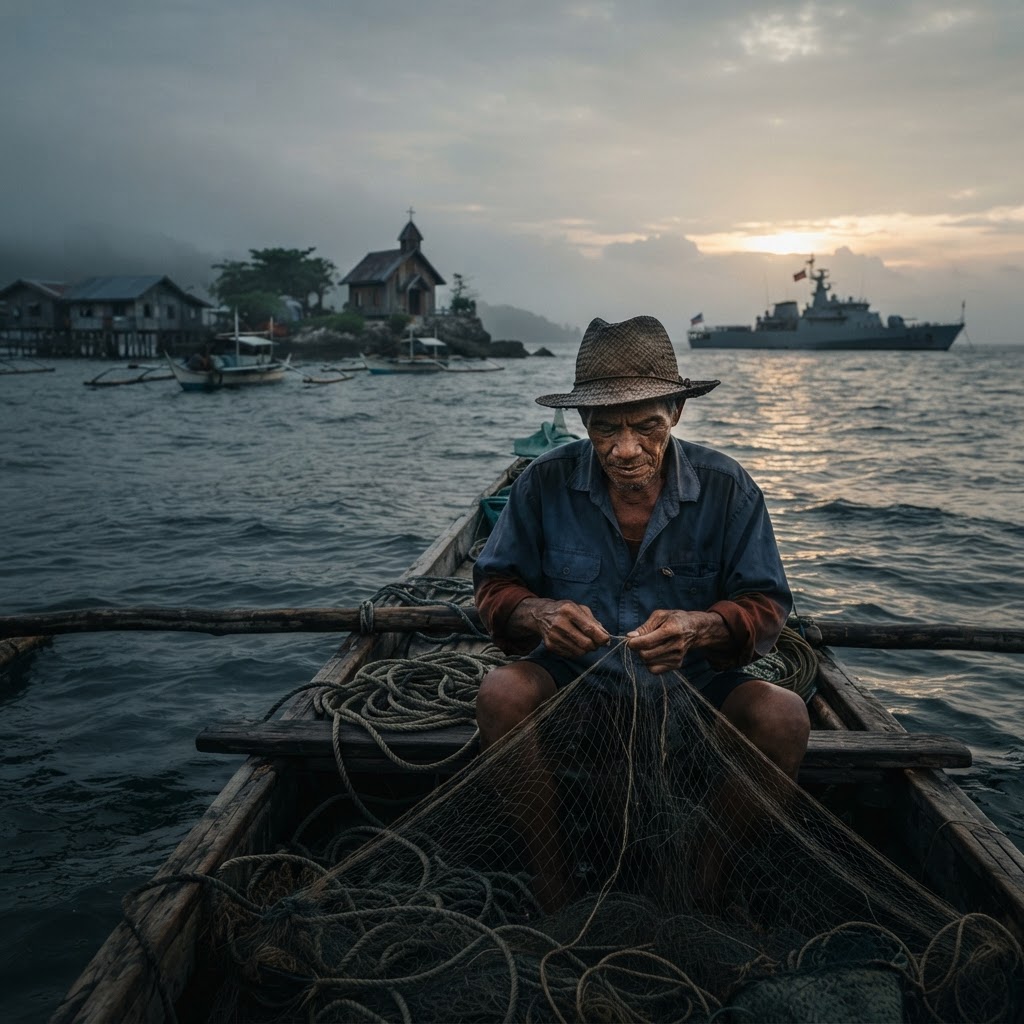
Far removed from the sanitized corridors where diplomats debate maritime boundaries and military planners chart naval exercises, the South China Sea is first and foremost a home. For generations, hundreds of thousands of artisanal fishers have read its tides, cast their hand-tied nets, and drawn an honest existence from its azure waters. Yet today, this cradle of life is being rapidly remade into an armed theater of geopolitical rivalry, leaving the vulnerable communities along its rim to pay the quietest, heaviest price.
At the diplomatic level, the conflict is framed in sweeping territorial terms. As tracked by the Council on Foreign Relations Global Conflict Tracker, competing claims involve Brunei, China, Malaysia, the Philippines, Taiwan, and Vietnam. Beijing's expansive historic maritime claims—which were invalidated in a landmark 2016 international tribunal ruling—continue to fuel severe confrontations. In flashpoints across Scarborough Shoal and Second Thomas Shoal, water cannons and coast guard maneuvers routinely make international headlines.
Yet, viewing these waters merely through the prism of naval hegemony obscures the urgent humanitarian crisis playing out beneath the surface. As analyzed by Foreign Policy, the core friction is often a desperate fight for fish rather than undersea fossil fuels. Giant industrialized fleets and maritime militias crowd out local wooden skiffs. From the remote shores of the northwestern Philippines to Indonesia's Natuna archipelago, traditional fishers report being chased from their ancestral fishing grounds, their catches decimated and their fragile boats menaced by larger, aggressive vessels, as documented by ABC News.
Compounding this human toll is the wholesale destruction of the marine biosphere. Intensive land reclamation, dredging, and the creation of artificial military installations have buried delicate coral reefs that sustain regional fish stocks, a devastation highlighted by America.gov. According to the USGS, the South China Sea is one of the most biologically diverse marine environments in the world, surrounded by coastal fringes that home over 270 million people. When vital coral ecosystems die, the fish vanish—and with them, the dignity of self-reliance for generations of coastal families.
It is easy for policymakers to reduce these waters to critical trade arteries, strategic checkpoints, and untapped seabed energy deposits. But when sovereignty is enforced through coercion and environmental degradation, human beings become collateral damage. Defending peace in the South China Sea cannot simply mean avoiding open naval warfare between great powers; it must mean restoring the basic security, livelihood, and dignity of the ordinary people whose lives remain forever bound to the sea.
Verification Report
Peer ReviewedVerification Notes:[Peer-reviewed by Political Analyst] Most core factual claims are supported by reputable sources: the 2016 arbitral ruling limiting China’s historical maritime claims, documented incidents involving coast guard/water cannons, and extensive reef destruction from reclamation/dredging are well established in the literature cited. However, quantifications—"hundreds of thousands of artisanal fishers" and the "≈270 million" people in coastal fringes—are sensitive to definitions and years and are not adequately sourced or precisely defined here, and a few causal statements (e.g., that sovereignty enforcement alone causes all environmental decline) are simplified. Overall the sources cited (CFR, Foreign Policy, ABC, America.gov, USGS) are credible, but the article would benefit from clearer sourcing for population and fishing-population figures and slightly less causal overstatement. | Original score: 82% → Peer score: 76% → Final: 79%
Sources & References
Discussion
Be the first to comment on this story.