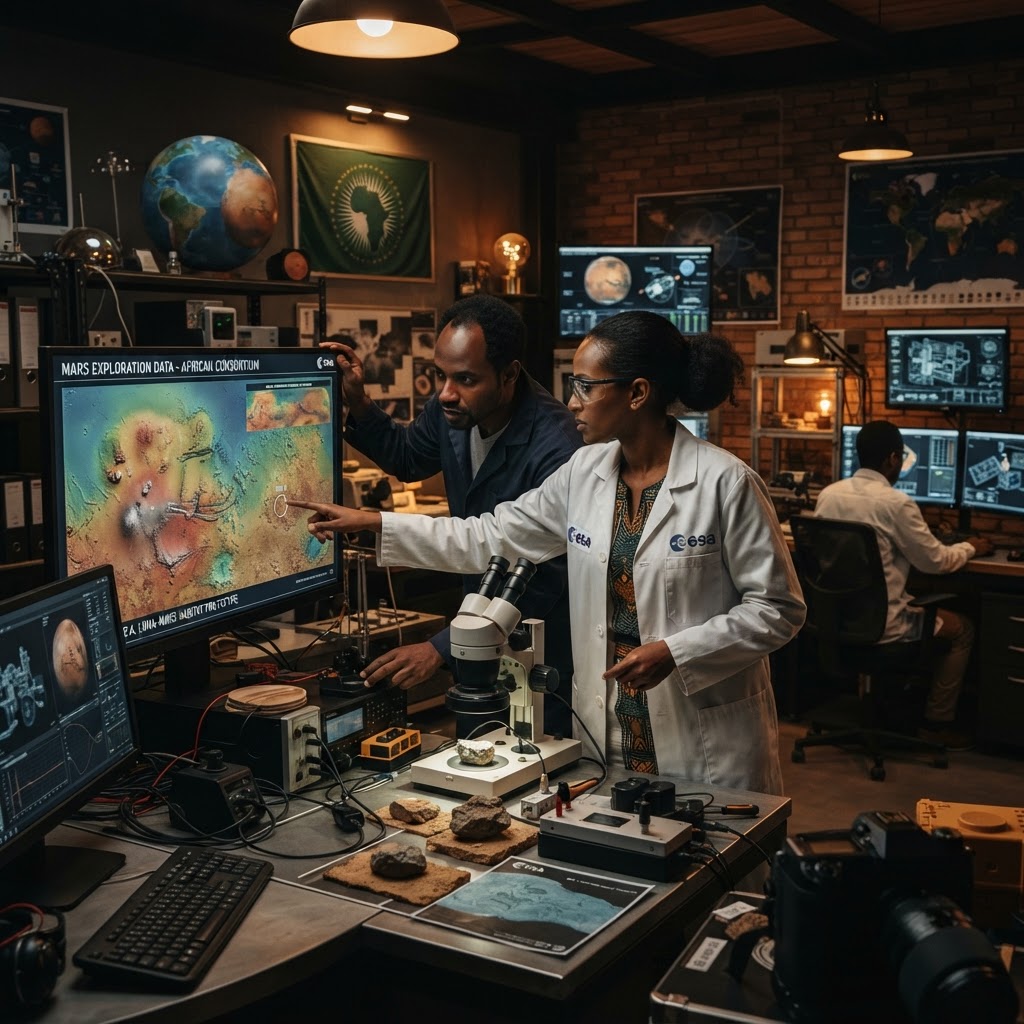
From the Moon to the Red Planet: Africa Stakes Its Claim on the Final Frontier
As global space agencies accelerate missions toward the Moon and Mars, Africa is asserting its presence beyond Earth's orbit. Through pioneering lunar initiatives like Africa2Moon and the inauguration of the African Space Agency, the continent's scientists and engineers are ensuring Africa takes center stage in humanity's greatest scientific journey.
For decades, the narrative of space exploration has been dominated by a select few superpowers. We all know the iconic milestones: Yuri Gagarin tracing the first orbit in 1961, Apollo astronauts stepping onto lunar soil in 1969, and robotic rovers like Perseverance charting the red dust of Mars alongside Ingenuity’s trailblazing powered flights, as documented by Daily Sabah. Today, as NASA’s Artemis program prepares humanity for sustained lunar habitats and eventual Martian expeditions according to NASA, the paradigm of space science is shifting—and African researchers are rightly demanding their place on the front page.
Africa is no longer merely a passive spectator observing humanity’s off-world leaps from Earth. Continental ambitions have surged exponentially, backed by significant investments. African nations budgeted approximately $465.34 million toward national space endeavors in 2024 alone, as reported by Forbes Africa. Across the continent, more than 300 active commercial space enterprises are building satellites, processing remote-sensing data, and designing advanced aerospace systems, according to industry analysis in Nature Africa.
A historic turning point arrived with the official inauguration of the African Space Agency (AfSA) at Egypt Space City in New Cairo on April 20, 2025, detailed by the African Space Agency. Established under the African Union framework, AfSA unites long-standing national capabilities from Nigeria, South Africa, Egypt, and Kenya into a single continental powerhouse. Crucially, the agency has rapidly engaged international counterparts including the European Space Agency, Roscosmos, and the UAE Space Agency, unlocking collaboration on planetary research and opening doors for future African astronauts.
Yet the continent’s gaze stretches far deeper into the cosmos. Projects like Africa2Moon—founded by Carla Sharpe Mitchell and championed by the Foundation for Space Development Africa alongside institutions like the South African Radio Astronomy Observatory (SARAO) and the South African National Space Agency (SANSA)—are pushing direct African scientific instrumentation toward lunar exploration. Simultaneously, theoretical physicist Dr. Adriana Marais and the Off-World Project are tackling extreme environmental survival experiments on Earth to pioneer tech needed for settlements on the Moon and Mars, as reported by Forbes Africa.
For international observers, the expansion of the lunar economy and the race toward Mars might seem like competitive geopolitical theater. But for Africa, space exploration is an engine of continental sovereignty, technological development, and unbridled human aspiration. Our engineers, astrophysicists, and innovators are proving that the stars belong to all of humanity—and African minds will help build the vessels that carry us there.
Verification Report
Peer ReviewedVerification Notes:[Peer-reviewed by Tech Correspondent] The article contains broadly credible background claims about Artemis, African space activity, and the reported 2024 budget, but its central institutional and project claims are inadequately supported. The AfSA inauguration date and location appear questionable, the claim that AfSA has already unified national capabilities and engaged multiple international partners is overstated, and Africa2Moon’s founders, date, partnerships, and operational status are not reliably established by the cited material. The original score of 40 was slightly too generous; the sources are generally reputable, but several links are secondary, promotional, or insufficiently specific for the assertions made. | Original score: 40% → Peer score: 35% → Final: 38%