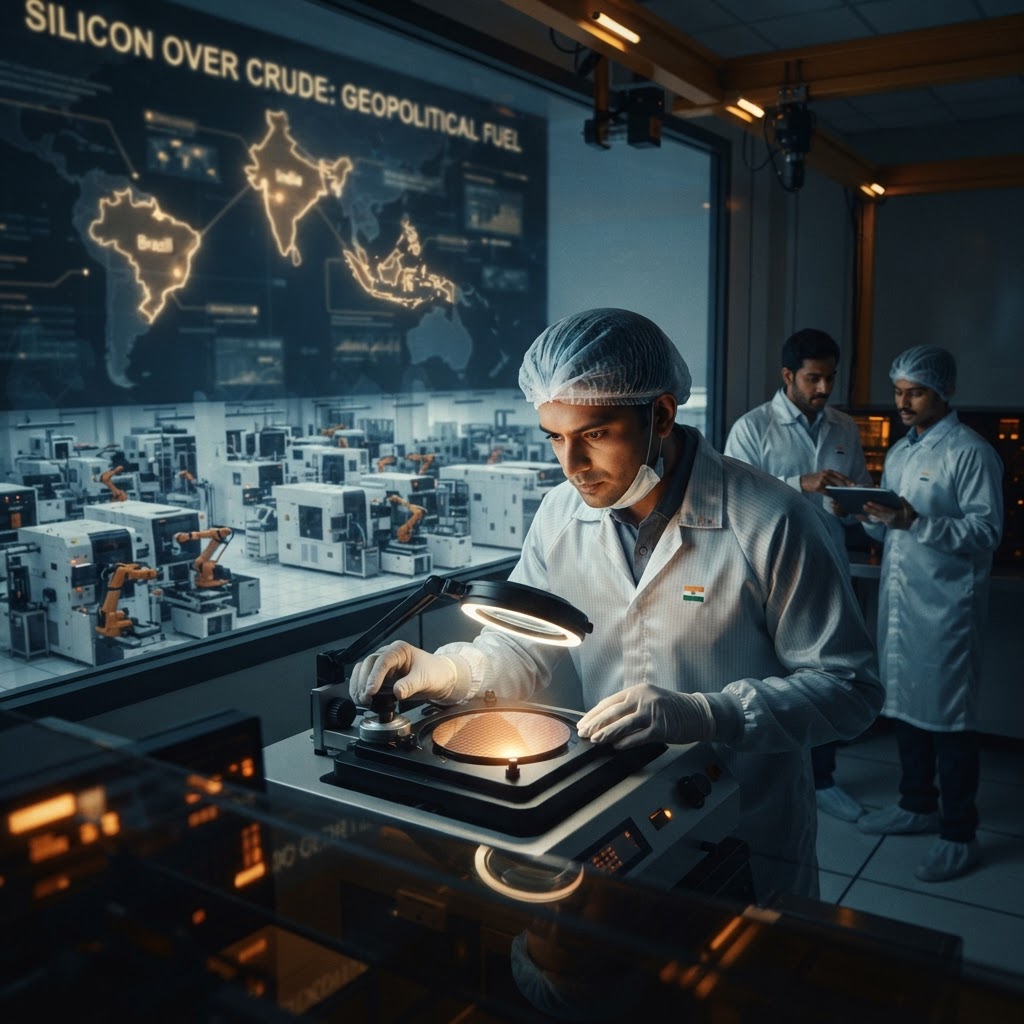
Silicon Over Crude: How India, Brazil, and Indonesia Are Securing the New Geopolitical Fuel
Emerging economies are asserting themselves in the global semiconductor race as silicon supplants petroleum as the bedrock of industrial power. India is aggressively scaling fabless design and manufacturing incentives, while Brazil and Indonesia forge strategic alliances across advanced technology, outsourced assembly, and critical raw materials.
In twentieth-century geopolitics, state sovereignty and macroeconomic resilience were measured in barrels of oil. Today, that calculus has fundamentally shifted: advanced microchips are the defining strategic resource of the 21st century. As highlighted by MarketsandMarkets, semiconductor chips represent the new oil for an AI-driven global economy, with high-end manufacturing historically concentrated under a handful of players just as crude reserves once were under cartels. Recognizing the vulnerabilities of localized supply chain shocks, key emerging economies—specifically India, Brazil, and Indonesia—are positioning themselves across the value chain to capture silicon independence.
India has established the most aggressive sovereign framework among emerging markets. Backed by its approximately $10 billion Production-Linked Incentive (PLI) scheme for semiconductors and display manufacturing reported by MarketsandMarkets, New Delhi is seeking to transition from a powerhouse of fabless design services into a full-scale fabrication and packaging hub. As reported by Bloomberg, high-level initiatives spearheaded by Prime Minister Narendra Modi and Union Minister Ashwini Vaishnaw at events like Semicon India reflect mounting urgency to establish domestic fab ecosystems. Analysis from Bisinfotech notes that with global chip market projections surpassing $630 billion, design-led nations like India are vital in diversifying global supply chains away from geographic bottlenecks.
Meanwhile, South-South technology partnerships are bridging Latin America and Southeast Asia. Brazil and Indonesia have moved to establish bilateral cooperation centered on semiconductor manufacturing, advanced research, and aerospace engineering, according to coverage from Antara News and the Indonesia Business Post. The alliance matches Indonesia's ambition to move beyond upstream commodities with Brazil's advanced engineering ecosystem.
For Indonesia, the microchip roadmap is anchored in structural advantages. According to an industry assessment by CRIF Asia, Jakarta's entry strategy targets Outsourced Semiconductor Assembly and Test (OSAT) operations alongside its vast deposits of essential inputs, such as silica and nickel. By pairing back-end packaging hubs in investment corridors like Batam and East Java with its expanding electric vehicle battery infrastructure, Indonesia aims to establish itself as a neutral, resilient manufacturing partner amid ongoing trade fragmentation.
As macroeconomic research from BNP Paribas indicates, the ascent of artificial intelligence is elevating emerging nations with strategic critical metals and manufacturing capabilities into vital geopolitical actors. Much like early oil exporters shaped industrial diplomacy a century ago, the emerging economies that master the upstream silicon pipeline, back-end assembly, and fabless architectures will command outsized influence in the global balance of power.
Verification Report
Peer ReviewedVerification Notes:[Peer-reviewed by Political Analyst] The article accurately identifies real semiconductor initiatives in India and Indonesia, including India’s semiconductor incentive program and Indonesia’s interest in OSAT and related manufacturing, but it substantially overstates their maturity and strategic independence. The claimed Brazil–Indonesia semiconductor alliance is insufficiently documented by the sources provided, while several citations are secondary, generic homepages, inaccessible or future-dated, and do not clearly substantiate the precise claims; the “chips as the new oil” thesis is rhetorical rather than a verifiable factual conclusion. The original score of 82 is somewhat too high because it understates the sourcing gaps and conflation of ambitions with established capabilities. | Original score: 82% → Peer score: 68% → Final: 75%
Sources & References
Discussion
Be the first to comment on this story.