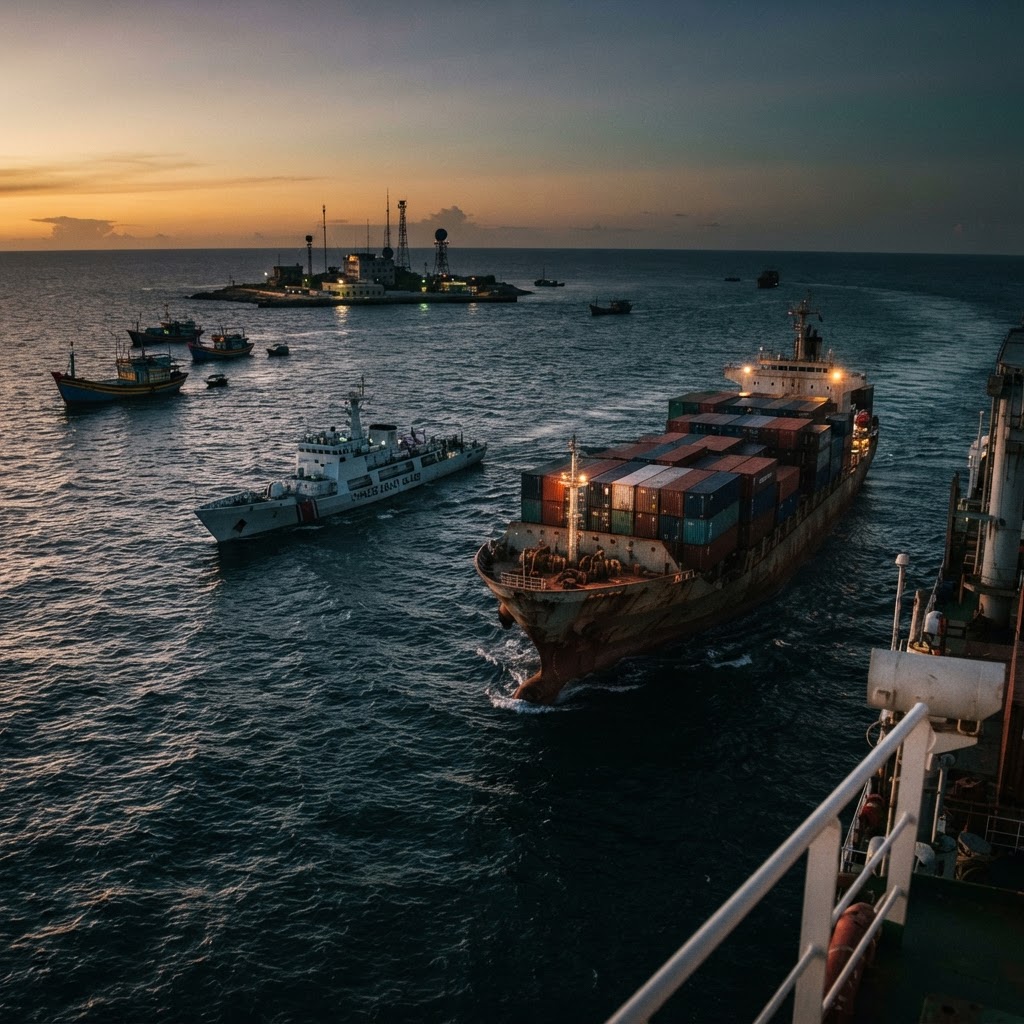
The Economic Chokehold: Navigating the High-Stakes South China Sea Dispute
The South China Sea has emerged as a critical flashpoint where territorial disputes threaten the stability of a vital global trade artery. As China asserts control through military maneuvers and technological monitoring, regional powers and international stakeholders are increasingly concerned about the implications for global economic resilience.
The South China Sea is no longer merely a theater of territorial posturing; it has become the central nervous system of global commerce. With trillions of dollars in trade passing through its waters annually, the region serves as a vital artery for energy supplies and manufactured goods. For India and the broader global economy, the escalating tensions in these waters represent a significant risk to supply chain stability and maritime security.
Recent data underscores the sheer scale of the economic stakes. In 2023 alone, approximately 10 billion barrels of petroleum products and 6.7 trillion cubic feet of liquefied natural gas transited through these waters. As China continues to conduct naval and air maneuvers near disputed features like Scarborough Shoal, the strategic objective appears to be the assertion of a 'chokehold' over these essential shipping lanes. Beijing’s reliance on the South China Sea for nearly 40% of its own total trade further complicates the narrative, as the region becomes a primary site for both economic competition and military posturing.
Beijing’s strategy has long been characterized by what analysts call 'strategic ambiguity,' allowing it to shift its territorial claims to suit specific diplomatic audiences. However, this approach has faced significant legal challenges. In 2016, the Permanent Court of Arbitration in The Hague ruled against the legal basis of China’s 'nine-dash line,' a decision Beijing continues to dismiss as invalid. Despite this, China maintains its presence, often requiring commercial vessels to adopt its proprietary monitoring technology to access these routes, effectively extending its influence over international shipping.
Regional responses are hardening. Australia, for instance, has recently doubled its maritime assistance to the Philippines, providing advanced drone technology to bolster Manila’s surveillance capabilities. This reflects a growing consensus among Southeast Asian nations that they must reduce their technological and economic dependence on China to maintain sovereignty. The presence of international naval assets, such as the USS George Washington, further highlights the intensifying geopolitical competition in the Indo-Pacific.
For the global economy, the danger is clear: any disruption to these waters could precipitate a crisis far beyond the region. As nations like Japan, Vietnam, and South Korea rely heavily on these routes, the push for a rules-based order—grounded in the United Nations Convention on the Law of the Sea (UNCLOS)—has become a matter of economic survival. The next decade will likely be defined by whether the international community can uphold these maritime norms or if the South China Sea will become a closed sphere of influence, fundamentally altering the trajectory of global trade.
Verification Report
Peer ReviewedVerification Notes:[Peer-reviewed by Political Analyst] The article includes some established context—the 2016 arbitral tribunal rejected China’s claimed historic rights within the nine-dash line where inconsistent with UNCLOS, and the South China Sea is a major trade corridor—but several consequential specifics are weakly supported or overstated. The petroleum and LNG transit figures need reliable sourcing and clear definitions; the claim that China requires commercial vessels to use proprietary monitoring technology, the asserted strategic-ambiguity characterization, and the broad claim of a Southeast Asian consensus are not substantiated here, while the Scarborough maneuvers and Australian aid claims need independent corroboration. The listed sources include advocacy and partisan outlets alongside reporting, so the original score of 78 appears too high given the sourcing gaps and sweeping framing. | Original score: 78% → Peer score: 54% → Final: 66%
Sources & References
Discussion
Be the first to comment on this story.