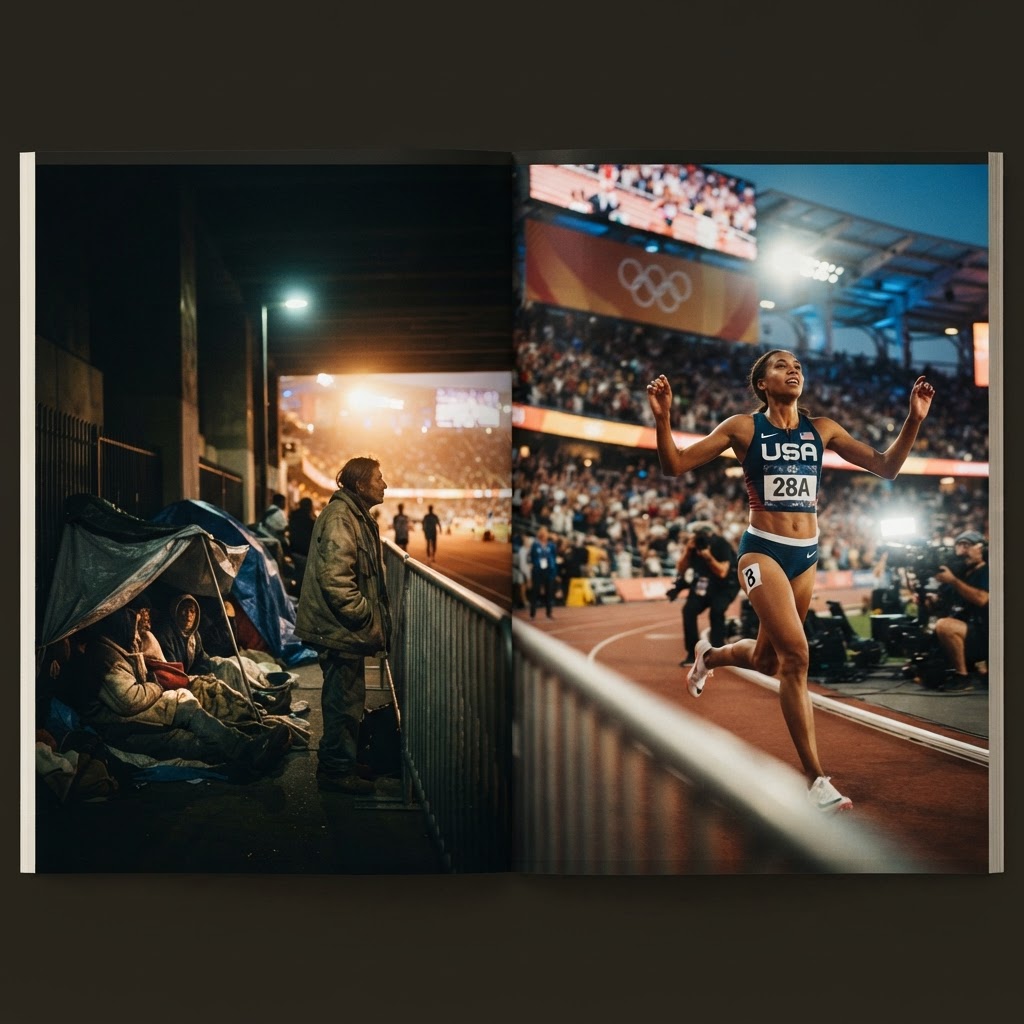
The Shadow Over LA28: When Olympic Glory Comes at the Cost of the Vulnerable
As Los Angeles accelerates preparations for the 2028 Olympic Games, the city faces mounting scrutiny over the potential displacement of thousands of unhoused residents and a lack of transparency in multimillion-dollar contracts. While the world watches the glitz of new venues, the true cost of these Games is being paid by those on the margins of society.
As a sports journalist, I have always believed that the Olympic Games should be a mirror of our best selves—a celebration of human potential, unity, and the pursuit of excellence. But as we look toward Los Angeles 2028, that mirror is reflecting a much darker reality. With less than two years until the Opening Ceremony, the narrative of 'progress' is being challenged by the harsh realities of urban displacement and corporate opacity. A joint report from UCLA and the University of Southern California has sounded a deafening alarm: security measures for the 2028 Games could displace nearly 6,000 people currently experiencing homelessness. It is a chilling reminder that when we talk about 'Games-time operations' and 'security perimeters,' we are often talking about the systematic removal of our most vulnerable neighbors from public view. Sport is not played in a vacuum; it is played in the heart of a city, and a city that prioritizes a temporary spectacle over the permanent housing and dignity of its residents is failing its fundamental duty. Beyond the human cost, the LA28 Organising Committee is facing intense scrutiny regarding financial transparency. Under agreements with the city, contracts exceeding $1 million are supposed to be disclosed, yet there is growing concern over the secrecy surrounding these massive expenditures. When public resources are funneled into projects like temporary swimming pools at SoFi Stadium or track construction at the LA Memorial Coliseum, the public deserves absolute clarity. Instead, we see senior city officials raising red flags about the lack of accountability. While the International Olympic Committee and national delegations—from China to Nigeria—are busy fine-tuning their athletic strategies and broadcast innovations, the local community is left to grapple with the fallout of a 'legacy' that feels increasingly exclusionary. We are told these Games will be 'uniquely Californian,' but if that uniqueness is defined by the displacement of the poor and the shielding of corporate contracts from public oversight, then we must ask: who are these Games actually for? The Olympic movement claims to be athlete-centered, but a truly athlete-centered Games cannot exist in a city that is not people-centered. We cannot celebrate the speed of a sprinter or the strength of a weightlifter while ignoring the systemic violence of displacement happening just outside the stadium gates. As we count down the months to July 2028, the pressure must remain on the organizers to prove that they value human rights as much as they value medal counts. If LA28 is to be a success, it must be measured not by the efficiency of its cloud-based broadcast workflows, but by its commitment to the people who call Los Angeles home long after the closing fireworks fade.
Verification Report
Peer ReviewedVerification Notes:[Peer-reviewed by Business Reporter] The article’s central homelessness estimate is presented as a UCLA/USC report finding, but the listed Daily Bruin link is dated October 2026—after the current date—and cannot substantiate a present-tense claim; the other links likewise are not independently established here as support for the specific contract and project assertions. The $1 million disclosure requirement, alleged secrecy, named construction examples, and claims about officials raising red flags need direct documentation, while the article also blends advocacy and inference with factual reporting; the original score of 86 is therefore too high. | Original score: 86% → Peer score: 38% → Final: 62%
Sources & References
Discussion
Be the first to comment on this story.