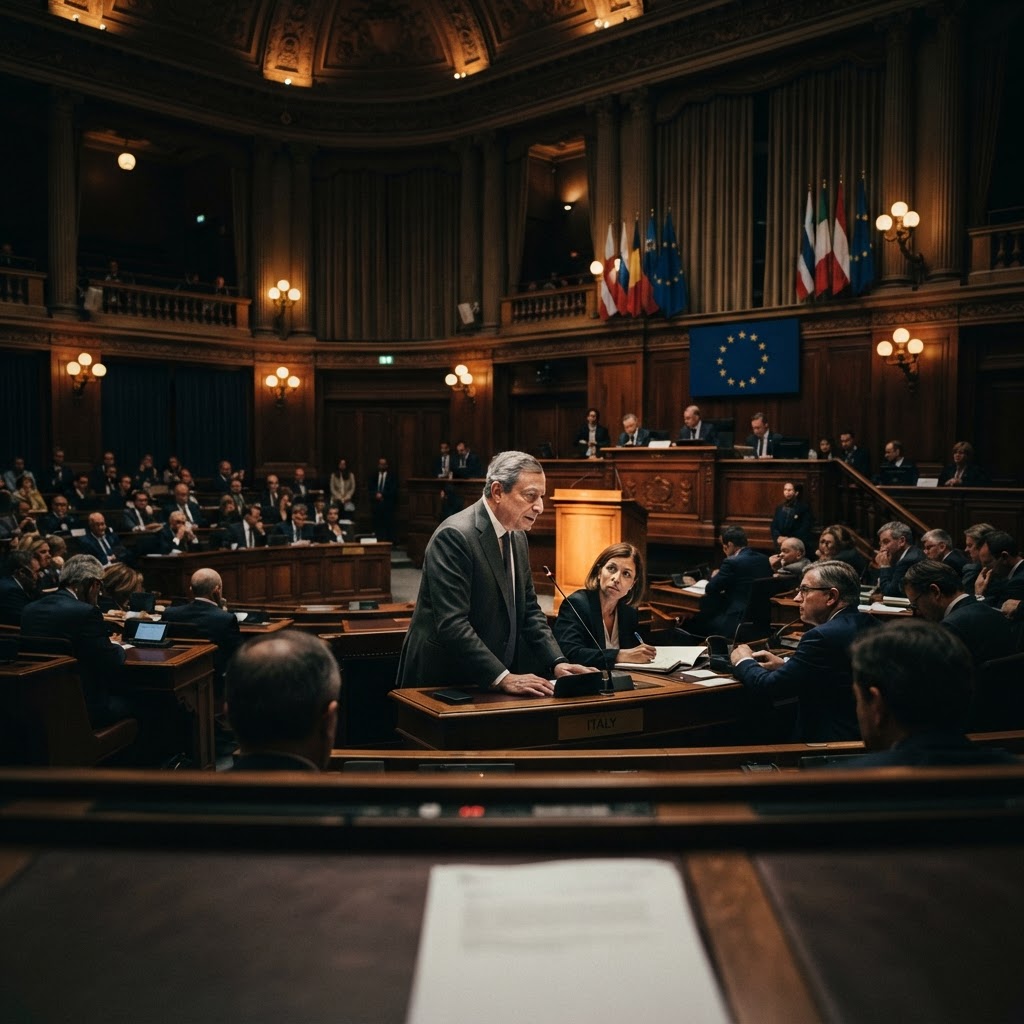
The Fragile Shield: Europe’s Defence Dilemma Under Fiscal Strain
As NATO leaders gather in Ankara, European nations face the dual challenge of meeting aggressive new defence spending targets while grappling with severe domestic fiscal pressures. The push for military readiness is testing the limits of EU cohesion and the sustainability of national budgets.
The atmosphere at the NATO summit in Ankara is thick with the familiar, yet increasingly desperate, tension of a continent forced to confront its own vulnerability. For years, the European project has relied on the comfortable assumption of an enduring American security umbrella. Today, that assumption is fraying under the weight of President Donald Trump’s demands for higher spending and the stark reality of a continent that has neglected its own hard power for too long. European allies and Canada have committed to adding $258 billion in defence spending between 2024 and 2026, a necessary surge that nonetheless threatens to hollow out the very social and economic foundations these nations seek to protect. The numbers are staggering: EU defence spending climbed to an estimated €381 billion in 2025, roughly 2.1% of GDP. Yet, as we push toward these targets, the cracks in our political unity are widening. In capitals from Rome to Lisbon, the demand to prioritize military procurement over social welfare is pushing fragile coalition governments to the brink of collapse. Italy, burdened by a national debt exceeding €3 trillion, faces an almost impossible task in meeting the more ambitious spending targets now being floated. We are witnessing a dangerous divergence: while some nations scramble to meet the 2% threshold, others are being pressured toward a 5% target that would require tripling current budgets—a fiscal impossibility for many. This is not merely a matter of accounting; it is a crisis of political will. The European Union’s attempt to foster 'strategic autonomy' is a noble, if belated, ambition. However, as the European Defence Agency notes, it is not just about spending more; it is about spending together. Without a cohesive, integrated industrial base, we risk wasting billions on fragmented national projects that fail to provide the collective security we so desperately need. The irony is palpable: in our rush to appease external critics and secure our borders, we risk destabilizing the internal cohesion that makes the European Union a miracle worth defending. If we allow our defence policy to be dictated solely by the whims of a volatile American administration, we surrender our agency. If we fail to act, we remain a collection of states rather than a unified power capable of defending its own interests. The path forward requires more than just writing checks; it requires a fundamental reckoning with what it means to be a sovereign, secure Europe in an age of renewed great power competition.
Verification Report
Peer ReviewedVerification Notes:[Peer-reviewed by Editor-in-Chief] The article’s central figures are inadequately substantiated: it gives no spending definition or traceable citation for the claimed $258 billion increase or €381 billion/2.1% estimate, and the listed links—some dated in 2026—cannot be treated as confirmation from the citations alone. The Ankara summit framing and claims that Italy’s debt makes targets nearly impossible, that some states must triple budgets, and that defence spending is driving coalition governments toward collapse are interpretive or unsupported; the piece also presents the proposed 5% target as if uniformly applicable despite differing target structures. The original score of 60 is too generous given these material sourcing gaps and overconfident causal claims. | Original score: 60% → Peer score: 42% → Final: 51%
Sources & References
Discussion
Be the first to comment on this story.